

Wildlife damage to perennial fruits and shrubs
UNIVERSITY OF MINNESOTA EXTENSION - www.extension.umn.edu

Rabbit damage on a shrub
My fruit trees and shrubs suffered severe wildlife damage this winter while I was focusing on other personal projects (a newborn baby). If your perennials are also suffering from wildlife damage, you are not alone in your frustration.
Upon surveying the damage in my garden, I determined the following:
- All of the primocanes in my large summer-bearing raspberry patch, which would have become fruitful floricanes this season, have been completely eaten.
- While my honeyberry was untouched almost the whole winter, the rabbits must have noticed it in the last couple of weeks. Despite the protective wrapping I placed around the shrub, they removed it and then shaved the outer bark off of about half of the canes.
- One of my young dwarf tart cherry shrubs will survive but now has only two main trunks instead of three. I will need to do some re-constructive pruning to compensate for the loss.
- My new boxwood was chewed to the ground.
- My primocane raspberries and primocane blackberries were left alone, although it would have been fine for critters to eat those since I will be pruning away the spent canes anyway.
There are three main types of wildlife damage you might observe on your perennials.
Stripped bark
Rabbits, voles and squirrels can all strip bark. In doing so, they may also leave small tooth marks on the wood.
According to John Loegering, Extension wildlife specialist, if the bark is stripped all the way around a branch, that branch will probably not survive. Prune off the damaged part of the branch, as the healthy portion of the branch below it is still likely to produce new leaves and shoots from the buds.
Chew marks
When a small mammal chews on a branch or trunk, they “girdle” it. Girdling partially cuts off the transport of water and nutrients from the roots to the canopy. Girdled branches are unlikely to survive for very long. Bite wounds also allow pathogens into the wood, introducing diseases like black rot.
Loegering says that if the tooth marks look like a scoop from a spoon, they are likely from a rabbit. If the mark looks like it was scraped with the tines of a fork, it is likely from a vole.
Complete removal of branches, trunks or canes
Cane or trunk removal is much more devastating for small, newly planted, or slow-growing shrubs compared to mature shrubs or fast-growing plants like raspberries.
In the case of my summer-bearing raspberries, the primocanes were completely removed above 6-12 inches above the ground. Since summer-bearing raspberries produce fruit on floricanes (the previous year’s primocanes), I will get no fruit from that patch this season.
What to do about existing damage
There is not much to do about existing damage except to be patient and let the plant regrow over time.
According to Shane Bugeja, UMN Local Extension Educator, applying sealants to wildlife wounds is unlikely to rejuvenate girdled perennials. If a mammal has chewed into the wood, the damage to the plant’s vascular tissue has already occurred regardless of the presence of a sealant.
Fertilize only if nutrient deficiency is detected
Support your plants by ensuring they have adequate soil nutrients. However, fertilizers are only recommended if a soil or tissue test indicates a nutrient deficiency.
If the plant is otherwise healthy and already getting all of the nutrients it needs, then additional fertilizer is unlikely to compensate for wildlife damage. Excess nitrogen can reduce fruit load in favor of vegetative growth and leach out of the soil into our precious Minnesota lakes and rivers.
Adjust pruning
If the damage consists of partial removal of trunks or canes, focus your pruning efforts on removing the damaged wood. Reduce pruning efforts on healthy wood to compensate for the lost growth.
As stated above, prune off damaged branches and canes below the lowest point of the damage.
Many fruiting plants like honeyberries, raspberries, and blueberries will continue to grow new canes from the base of the plant each year, so cane loss is not fatal to the plant.
When to remove a damaged plant
The worst case of wildlife damage would be a single-trunk plant like an apple or tart cherry tree, where the trunk has been stripped or girdled. Severe damage will likely either kill or severely limit the lifespan of the tree.
You can choose to wait out the season to see if the tree continues to survive, or remove the tree and plant a new one.
Preventing wildlife damage
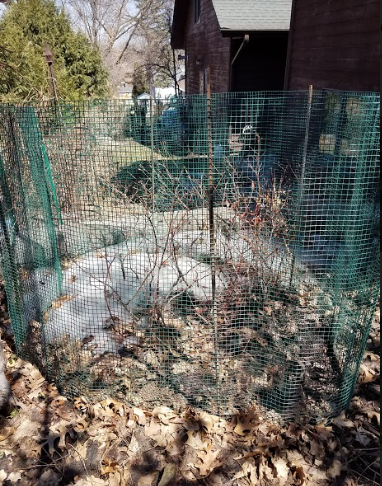
Fencing around blueberry shrubs
In the future, use wire mesh (rabbit fencing, chicken wire, etc.) to create a physical barrier around each plant. Apply this in the summer or fall.
The mesh should be narrow-gauge so that the holes are too small for a rabbit or vole head to fit through. The mesh must also be tall enough to rise one foot above the maximum snow depth. Rabbits can stand on snow and reach one foot above it. During the winter, if the snow becomes deep enough to approach the top of the mesh, you can shovel it away.
I choose to use tight-gauge mesh around the base of each plant, and then a tall, wider-gauge enclosure around that to exclude deer.
Keep an eye on your plants during the winter. Apply more mesh or fix existing structures as needed if you start to notice wildlife damage or droppings.
You can read more about protecting trees and shrubs from animal damage in our article, Protecting trees and shrubs in winter.
